
Meta ads for supplements: formats, hooks and creative that sells
Facebook and Instagram are where many supplement brands look for new customers, and the creative decides much of what you pay for them. This guide walks through how we plan Facebook supplement ads, step by step: the angle, the hook, the format, the placements, the words, the test, the follow-up and the refresh.
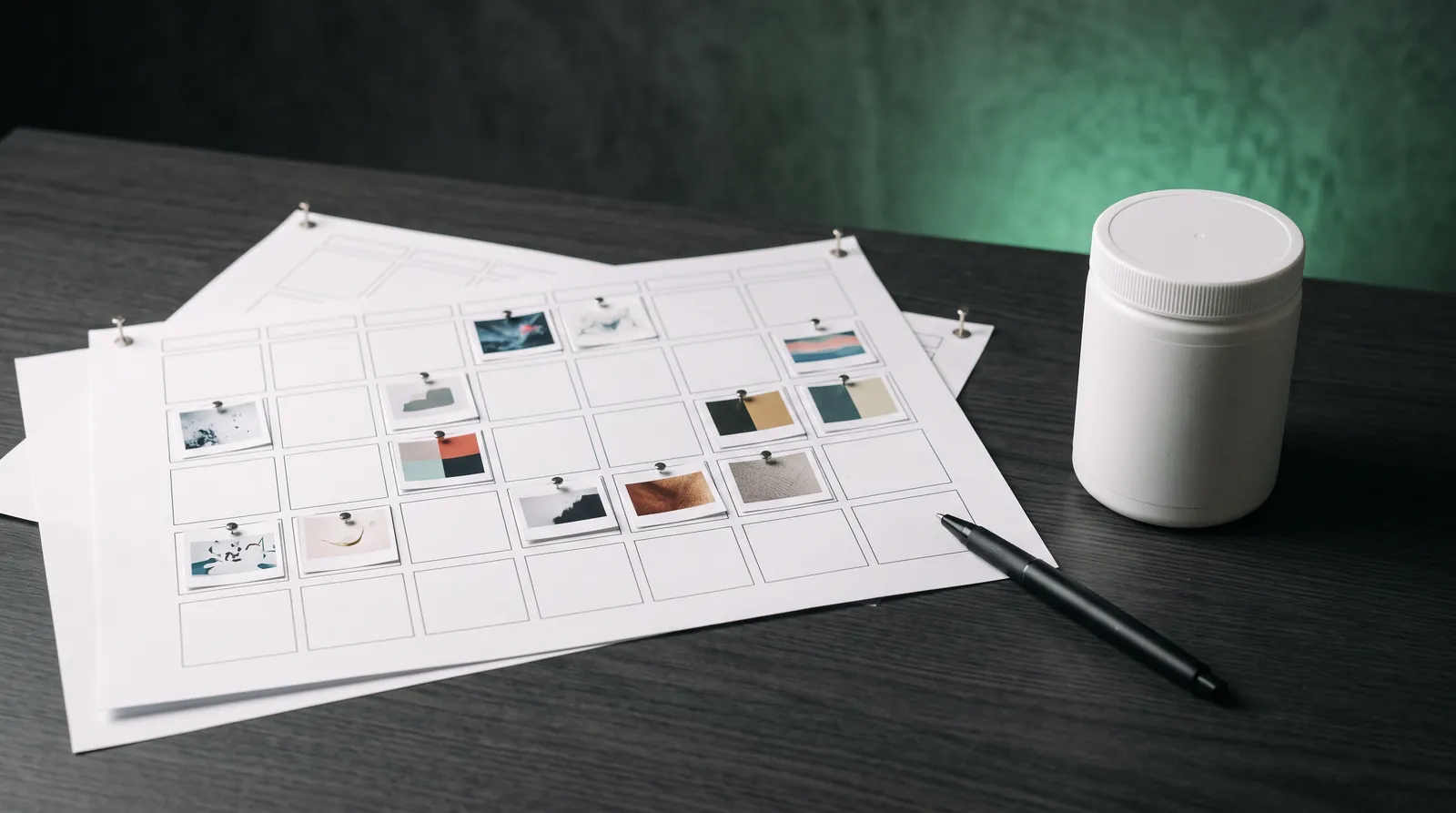
Every example is a concept ad we made for Northleaf, a fictional brand, so you can borrow any structure. At the end you can download our creative launch planner, the one-page sheet we use to plan a month of Meta creative.
Get the creative launch planner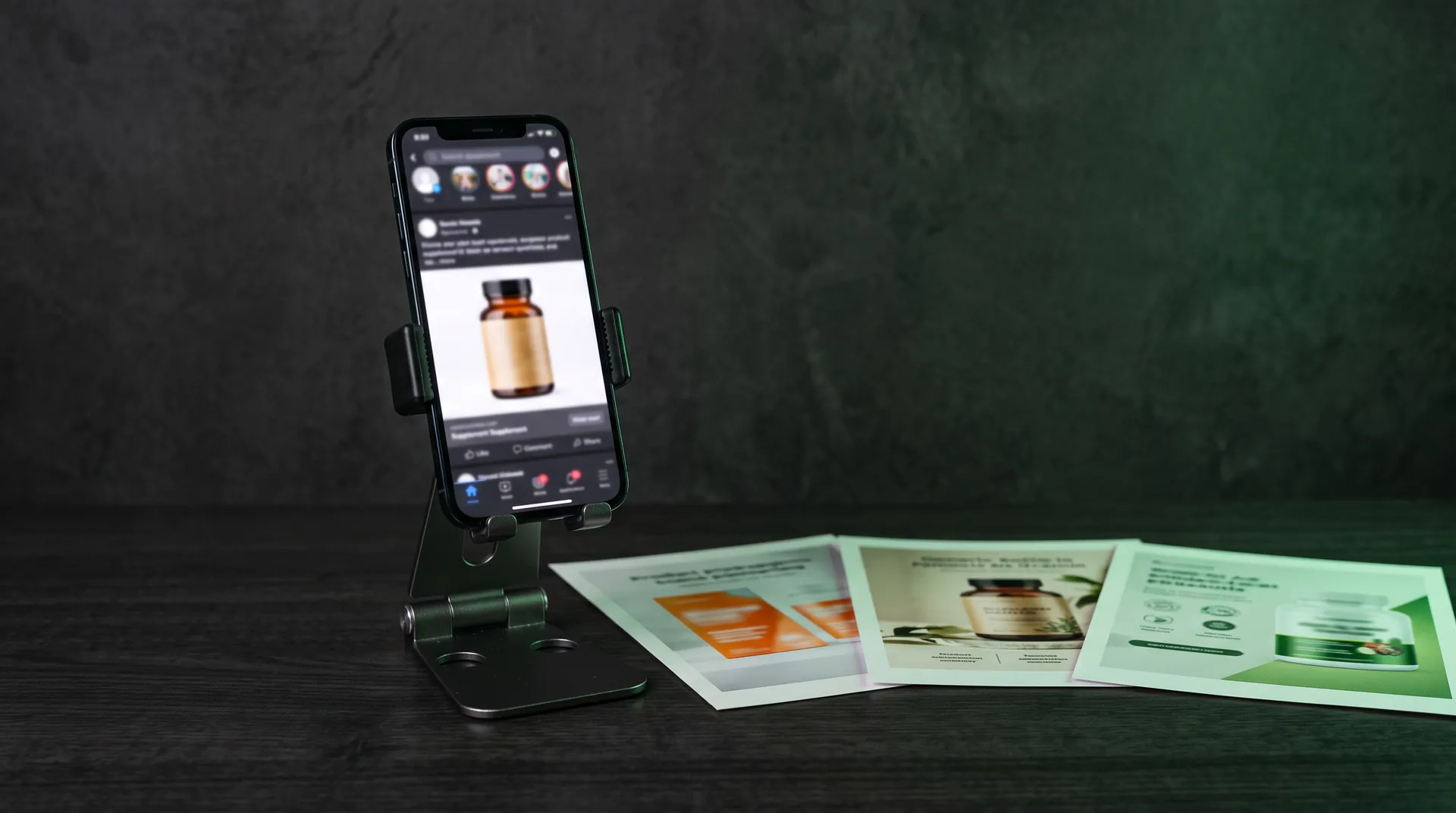
Step 1: Start from one buyer and one moment
A supplement ad works when the viewer sees their own day in it. Before you think about formats, write down who the ad is for and the moment in their day when the product matters. One buyer and one moment per concept. If you try to speak to everyone, the ad looks like a catalogue.
Good moments are specific and visual: the afternoon slump at a desk, the shaker bottle after a workout, the bedside table at night, the kitchen counter before school. Each one gives the ad a setting, a mood and a problem without a word of copy.
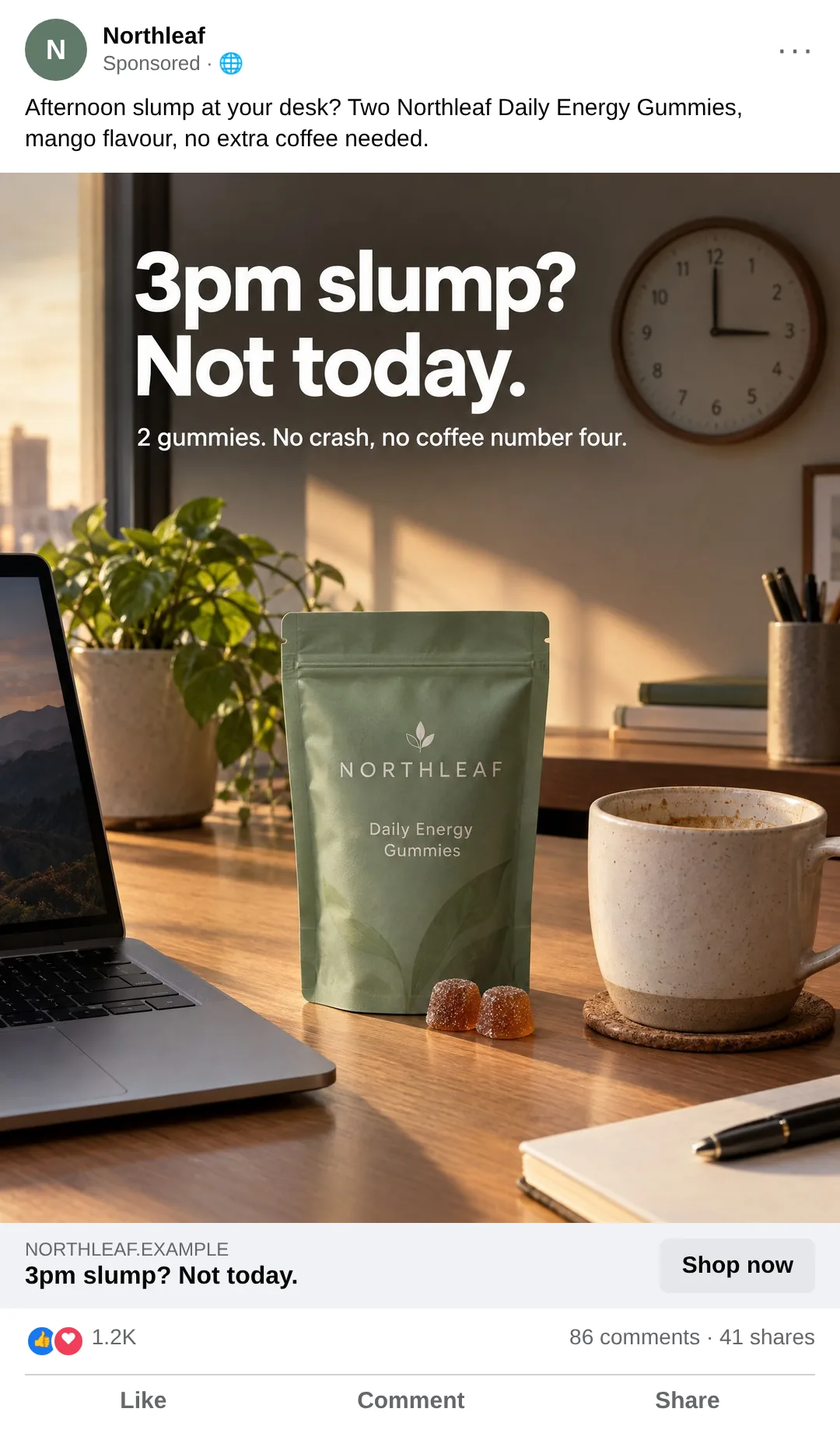
Worked example. Northleaf Daily Energy Gummies. Buyer: an office worker in their thirties who already drinks too much coffee. Moment: 3pm, still at the desk, the third coffee on the way. Everything in the ad that follows comes from that one line.
Step 2: Write the hook for the first second
In a feed, the image and the first line of text decide whether anyone reads further. The hook should name the moment from step 1 in as few words as you can. Short questions and plain statements work better than clever wordplay, because people read them at a glance.
Write at least five hooks for every concept before you choose. Then put the best two or three into the test (step 6) instead of picking a winner on instinct.
Worked example. For the 3pm moment we wrote: "3pm slump? Not today.", "Coffee number four can wait.", "Your afternoon, back on track.", "The desk-drawer snack that isn't a snack." and "Two gummies at 3pm." The first one went on the image, with a short line under it.
Step 3: Pick the format that fits the job
Each format does one job well. Choose by what the viewer needs to see, not by what is new on the platform.
| Format | Best job | Use it when |
|---|---|---|
| Static image | Test an angle fast | You have a new message and want an answer this week |
| Ingredient spotlight | Answer "what is in it?" | The ingredients are part of the reason to buy |
| Carousel | Show steps or several products | A routine, a bundle or a range |
| Short video | Show the product in use | Texture, taste, routine or the unboxing matter |
| Creator-style video | Borrow a real person's voice | You have real creators or customers who agreed to appear |
| Offer or reorder | Close the sale | The viewer already knows the brand |
Statics are the quickest way to learn which message works. Video is where a winning message scales. Creator-style ads use real creators or clearly labelled AI presenters, never an AI person shown as a real customer or expert.
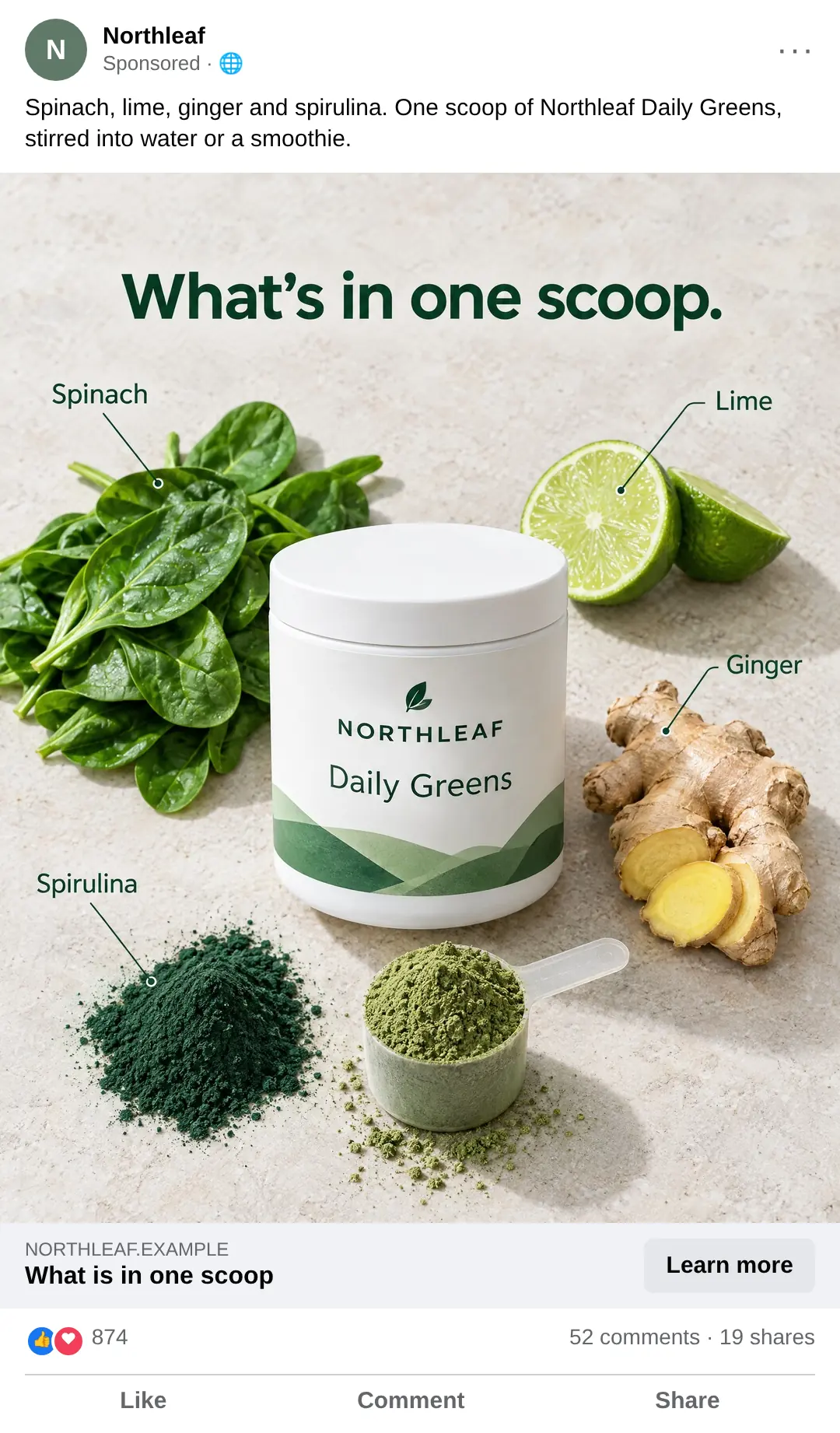
Worked example. Northleaf Daily Greens is bought for what is inside, so we used an ingredient spotlight: the tub, one scoop, and the four whole ingredients around it, each labelled.
For more formats with notes on each, see our static ads examples and the free supplement ad swipe file.
Step 4: Build every ad for every placement
Meta shows the same ad in the Facebook and Instagram feeds, Stories and Reels. A file built for one place often looks cropped or crowded in the others. Plan each concept in three shapes from the start:
- 4:5 vertical for the Facebook and Instagram feeds.
- 9:16 full screen for Stories and Reels, with the headline and product kept clear of the top and bottom, where the interface sits.
- 1:1 square for smaller placements and the right column.
For video, add captions and design for sound off: many people scroll with the sound off, so the story has to read from the picture and the words on screen.
Worked example. The 3pm ad was planned with the headline in the top third and the pouch in the centre. In 9:16 the background extends above and below; the headline and pouch stay where they are, clear of the Stories interface.
Step 5: Write the words around the image
A Meta ad has three pieces of text besides the image: the primary text above it, the headline under it and the button. Each has one job.
- Primary text carries the hook again in plain words and adds one detail: the flavour, the dose, how it fits the day.
- Headline repeats the promise in five words or fewer, for people who skip the primary text.
- Button matches where the click goes: "Shop now" to a product page, "Learn more" to an article or a quiz.
Use only claims your team has cleared, word for word. Ask for the approved claim list before anyone writes copy, and keep it next to the brief. Describe the routine and the experience; leave health outcomes to the language your team signed off.
Worked example. Primary text for the 3pm ad: "Afternoon slump at your desk? Two Northleaf Daily Energy Gummies, mango flavour, no extra coffee needed." Headline: "3pm slump? Not today." Button: Shop now. In a real campaign the brand's team checks every line before launch, including the small line on the image.
Step 6: Launch a batch, not one ad
One ad tells you very little. A batch of clearly different concepts tells you which angle the audience cares about. Meta's delivery system also does better with variety it can match to different people, which we cover in why creative diversity matters on Meta.
We plan each launch as a few concepts, each with two or three hooks, in every placement shape. Change one thing at a time inside a concept, so you know what made the difference. Name every file so your media team can read the test: concept, hook, format, ratio.
Worked example. A Northleaf launch batch: the 3pm desk concept with three hooks, the ingredient spotlight with two hooks, and a routine video with two openings. Seven ads, three ideas, all in 4:5, 9:16 and 1:1. Names like NL-ENERGY-3PM-H2-STATIC-45.
For how to set up and read the test, see our creative testing guide. Health and wellness accounts also have their own optimization limits on Meta; we explain them in Meta purchase optimization for health accounts and Meta's health and wellness ad rules for 2026.
Step 7: Match the creative to where the buyer is
Someone who has never heard of the brand needs the moment and the hook. Someone who visited the product page needs a reason to come back. Someone who bought last month needs a reminder at the right time. One ad cannot do all three.
Plan at least one ad for each stage: a new-audience ad from steps 1 to 6, a follow-up for visitors that answers the most common doubt (taste, price per day, how to take it), and a reorder ad for customers timed to when a pack runs out.
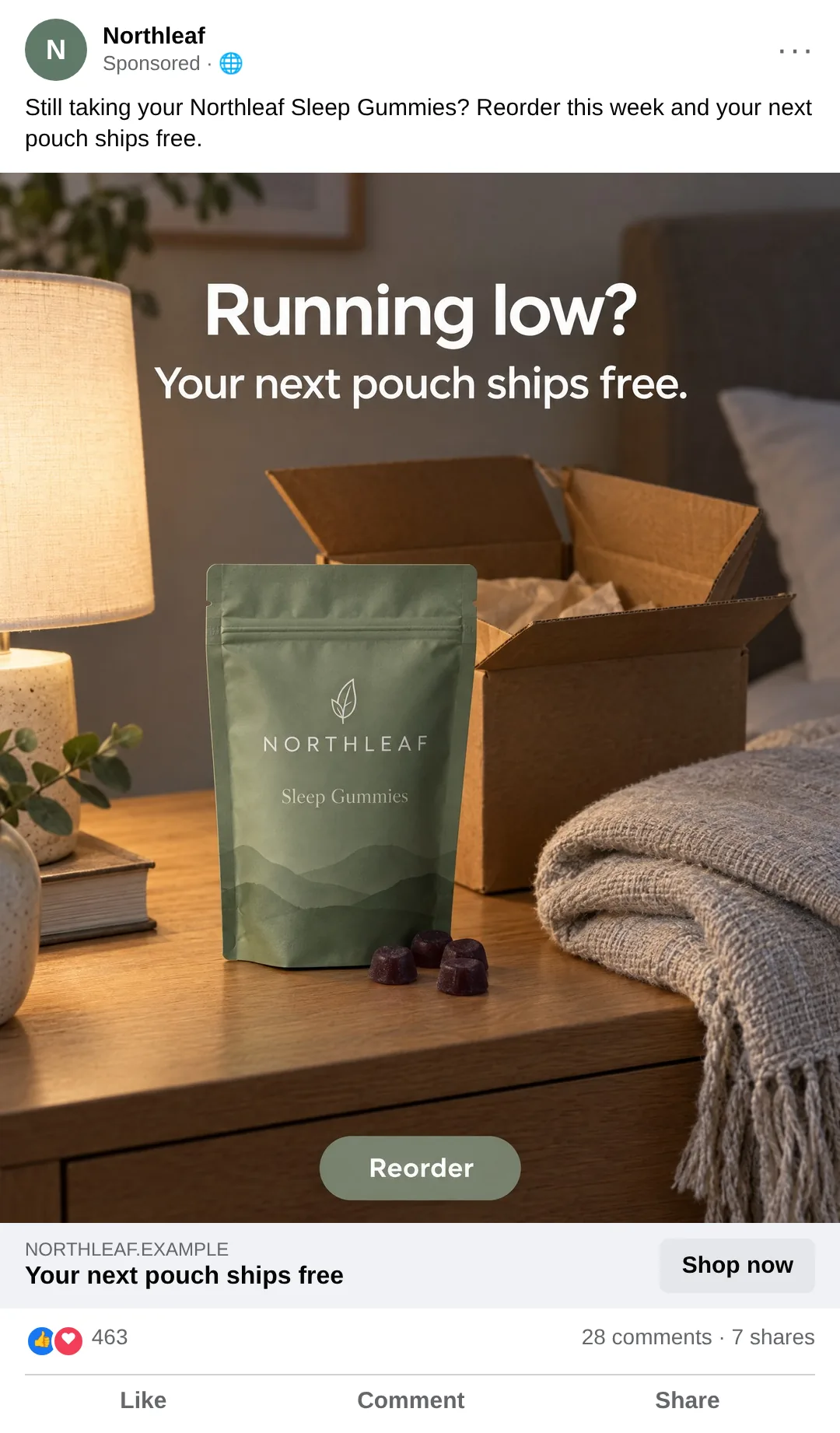
Worked example. For customers who bought Northleaf Sleep Gummies about a month ago, a calm bedside scene and two lines: "Running low? Your next pouch ships free." No new claim, just the product, the moment and an easy next step.
Step 8: Read the results and refresh on time
Look at the ads, not only the campaign. For each ad, check how many people stopped (thumb-stop or hook rate for video, click-through for statics), how many clicked, and what the clicks cost in sales. Keep the angles that win and write new hooks for them. Drop the angles that lose.
Every winner wears out. When the same people have seen an ad many times, results fall and costs rise. Refresh before that happens: a new hook, a new setting or a new format on the same winning angle. Our creative fatigue guide shows the signs to watch.
Worked example. If the 3pm angle wins, the next batch keeps it and changes the rest: a 9:16 video of the same desk at 3pm, a carousel of three afternoon moments, and two new hooks on the static.
Creative launch checklist
Run through this before a batch goes live.
- One buyer and one moment written down for each concept
- At least five hooks written, the best two or three in the batch
- Format chosen for the job the ad has to do
- Every ad built in 4:5, 9:16 and 1:1, headline and product clear of the interface
- Captions on every video, readable with the sound off
- Primary text, headline and button written for each ad
- Every claim taken word for word from your team's approved list
- Files named by concept, hook, format and ratio
- One ad planned for new audiences, one for visitors, one for customers
- A date set to review results and plan the refresh
Questions
Do supplement ads work on Facebook and Instagram? Yes, when the creative is built for them. The ads that work show a real moment in the buyer's day and use claims the brand can stand behind.
Statics or video? Both. Statics find the winning message quickly and cheaply. Video is where that message scales once you know it works.
How many ads should we launch with? Enough to compare clearly different ideas. We usually start with a few concepts, each with two or three hooks, in every placement shape.
Can we use AI in our ads? Yes, for production. Keep people in charge of the idea, the hook and the claims, and never show an AI person as a real customer or expert. Meta also asks for AI labels on some content; see our note on AI disclosure labels.
Who is responsible for the claims? Your brand. We flag risky phrasing while we write, but we are a production studio, not a legal or compliance service.
Get the creative launch planner
Plan your next month of Meta creative on one page: concepts, hooks, formats, placements and review dates. Leave your name and email and the planner downloads straight away.
Want this batch made for your product?
We plan and make Meta ads for supplement brands in 3 to 10 days, statics and video. Send one product link and we will make 10 ready-to-test static ads for your brand, handed over free on a 20-minute call.
Need ads every month? See our static image ads service and our video ad production for supplement brands.
Get my 10 free static ads