
The Complete Guide to Creative Fatigue and Refresh Cadence for Supplement Brands
How to spot a tiring ad early, work out whether creative is really the problem, and keep a steady flow of fresh ads without rebuilding your account every month.
What creative fatigue actually is
Creative fatigue is what happens when the people your ad can reach have seen it enough that it stops working. They scroll past it faster, click it less, and buy less often after clicking. The ad did not get worse. The audience got used to it.
For supplement brands this matters more than in most categories. You usually sell one product to a fairly narrow audience, you often run a small number of angles (energy, sleep, hair, gut, stress), and your ads tend to look alike because the bottle, the claim style and the compliance limits are all the same. Narrow audience plus similar ads is the fastest route to fatigue.
The goal is not to avoid fatigue. Every ad fatigues eventually. The goal is to see it early, understand it correctly, and have the next ad ready before the current one gives out.

The signs, in the order they usually show up
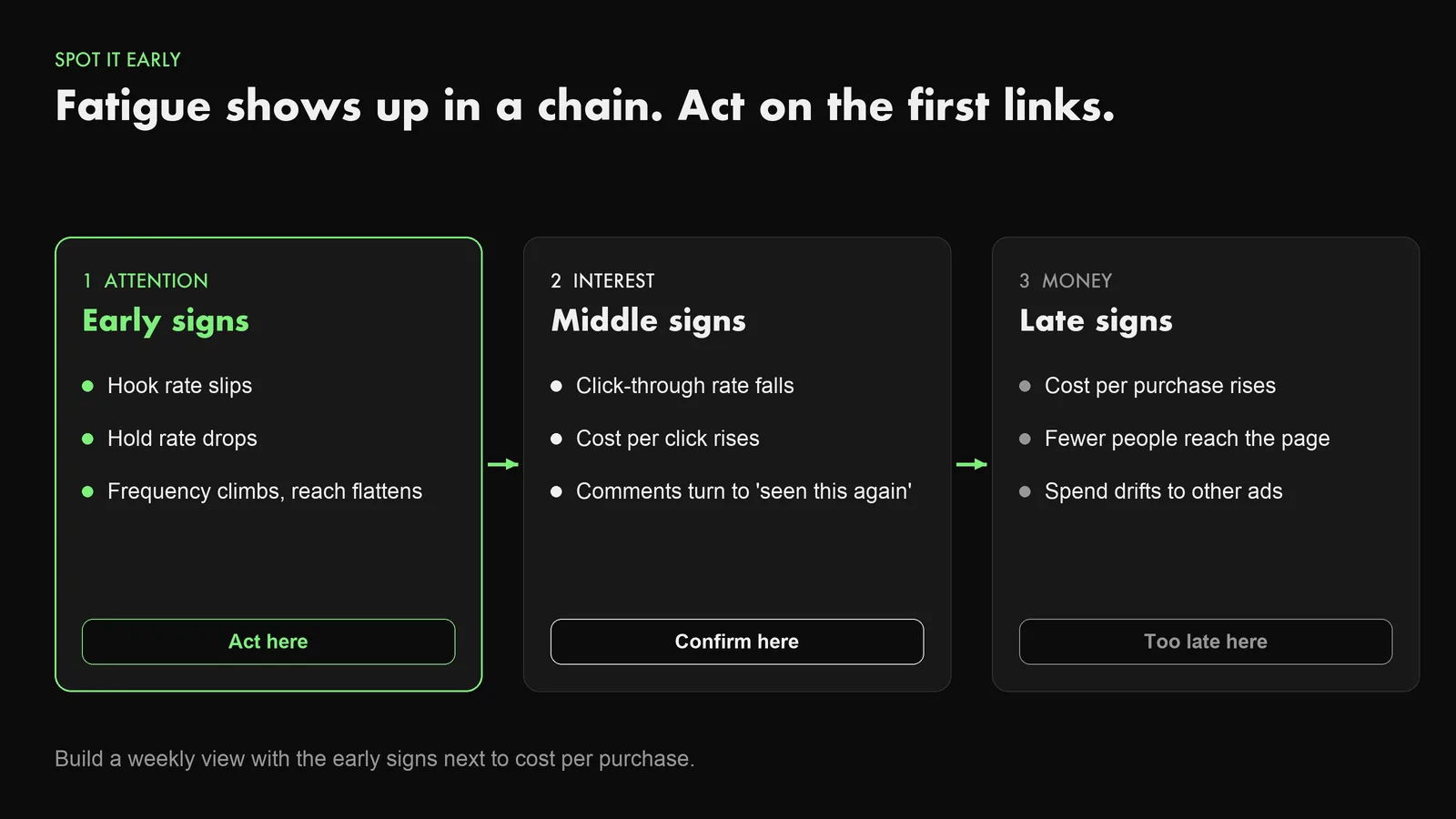
Fatigue rarely arrives as a sudden drop. It shows up as a chain. Watch the early links, because the late ones are expensive.
Early signs (attention):
- Hook rate or thumb-stop rate drifts down. Fewer people watch the first few seconds.
- Hold rate drops. People who stay stop watching as far into the video.
- Frequency climbs on the ad set while reach flattens.
Middle signs (interest):
- Click-through rate falls.
- Cost per click rises.
- Comments shift from questions to "I keep seeing this".
Late signs (money):
- Cost per purchase (or your best available proxy) rises.
- Conversion rate on the landing page looks fine, but fewer people get there.
- Spend moves to a different ad in the same ad set, and the new ad is not clearly better.
If you only watch cost per purchase, you will find out about fatigue last. For a shorter primer, read our insight Creative Fatigue Is Costing You More Than You Think. Build a simple weekly view with the early signs next to it. The creative testing guide covers which metric maps to which part of the ad, and the same mapping works here.
A note on measurement for health-classified accounts: some platforms limit which conversion events health and wellness accounts can optimize for. If your purchase signal is thin or delayed, lean harder on the early signs above, and check the current rules for your account directly with the platform.
Is it really fatigue? Diagnose before you refresh
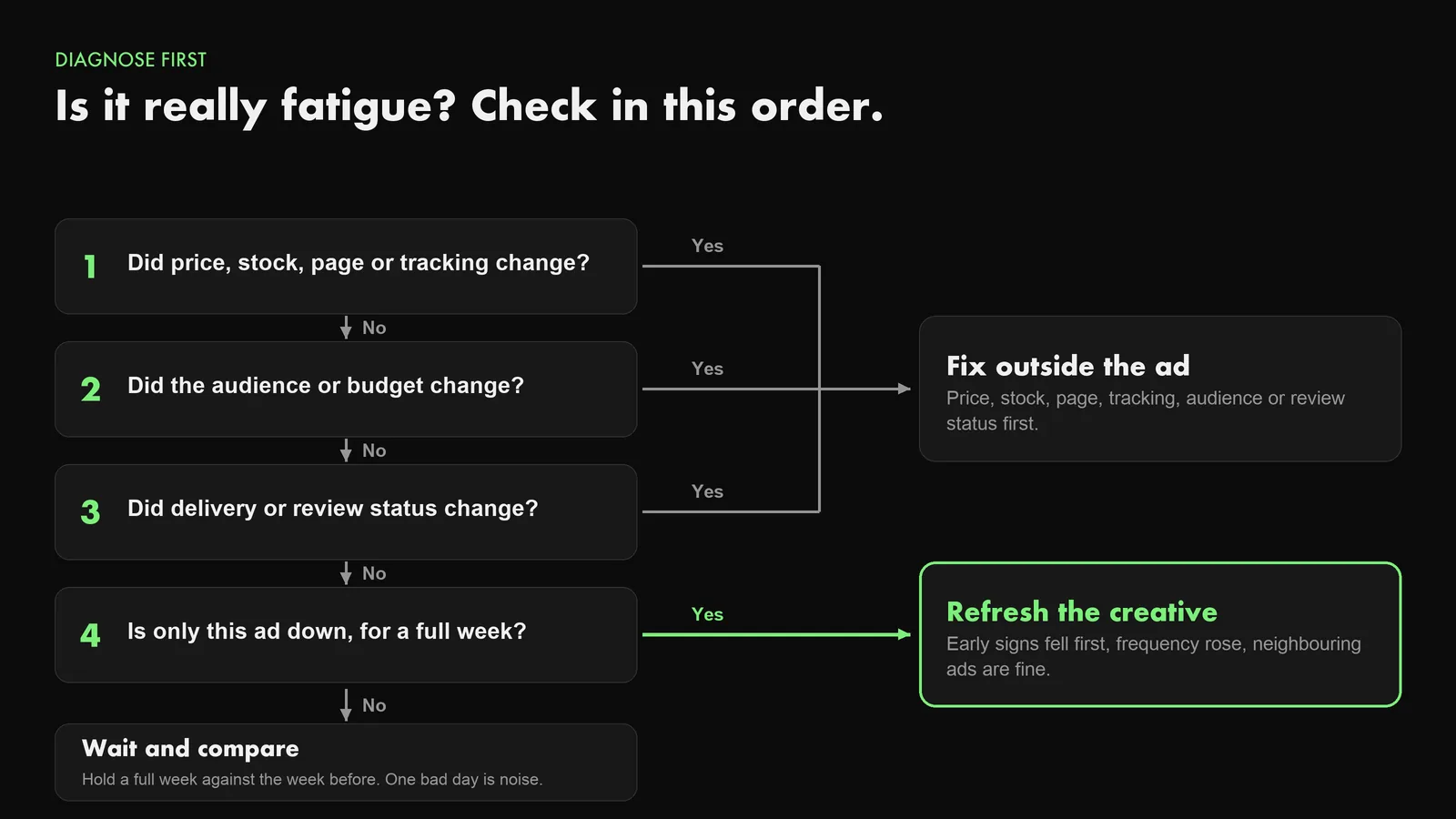
The most expensive mistake is replacing creative when the creative was never the problem. Before you brief anything new, run through this order.
- Did anything change outside the ad? A price change, a stock-out, a slow landing page, a new checkout step, or a tracking change can all look like fatigue.
- Did the audience change? A new targeting setup, a budget jump or a broad expansion changes who sees the ad. Early results from a new audience are not fatigue.
- Did delivery change? An ad that was approved and is now restricted, or an account that moved into a stricter review category, can drop in a way that has nothing to do with the creative.
- Is it only one ad, or the whole set? If one ad is down and its neighbours are fine, that ad is tired. If everything dropped on the same day, look outside the creative.
- Is the drop real or just noise? Small budgets swing a lot day to day. Compare a full week against the week before, not one day against another.
Only when the answer points at the ad itself, with the early signs falling first and frequency rising, treat it as fatigue.
Why supplement ads fatigue the way they do
A few patterns are specific to this category.
One angle, many copies. Many supplement accounts run ten edits of one idea. Platforms and viewers can treat these as the same ad. Changing the caption or the colour does not give people anything new to react to.
The same bottle shot. A clean product pack shot is useful once. Used in every ad it becomes wallpaper.
Compliance narrows the claims. You cannot lean on strong claims, so the creative has to do its work through story, person, setting and format. That makes variety in those four things your main lever. Compliance is always your own responsibility, so have your regulatory advisor review any claim or visual before it goes live.
Subscription economics reward patience. If most of your value comes from repeat orders, an ad that looks expensive on first purchase may still be worth running. Judge fatigue on the trend, not on a single day's cost.
The three levels of refresh
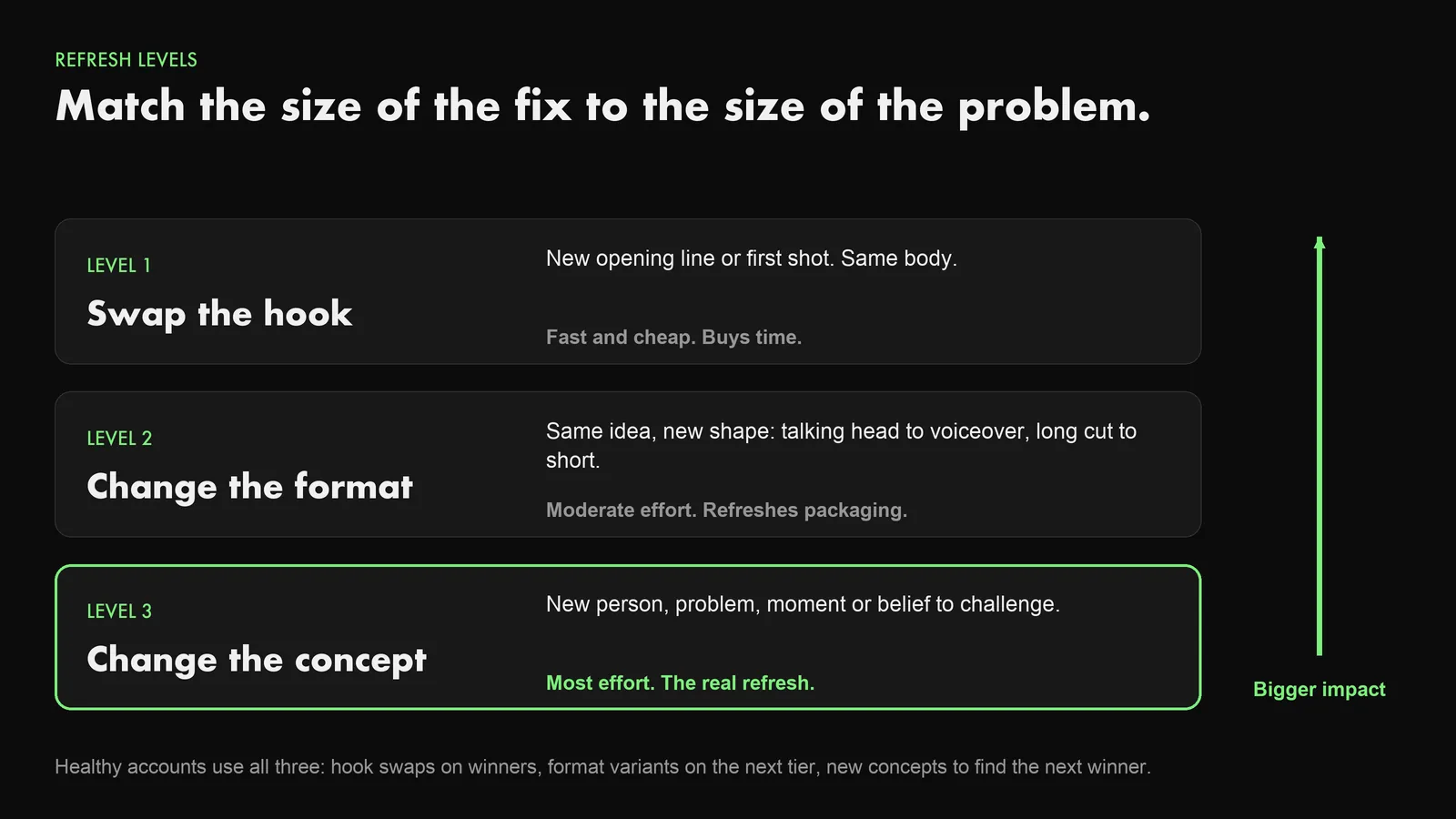
Not every refresh needs a new shoot. Match the size of the fix to the size of the problem. Think of three levels, from cheapest to most powerful.
Level 1: Swap the hook
Keep the body of the ad and change the first three seconds: a new opening line, a new first shot, a different on-screen question. This is the fastest fix and works well when hold rate is fine but hook rate has slipped. It buys time. It rarely changes the long-term curve on its own.
Level 2: Change the format
Take the same idea into a different shape: a talking head becomes a voiceover over b-roll, a testimonial becomes a split-screen explainer, a long edit becomes a short cut. The message stays, the way people receive it changes. This helps when the idea is still good and the packaging is tired.
Level 3: Change the concept
Start from a different reason to care: a different person, a different problem, a different moment in the day, a different belief to challenge. This is the real refresh. It is also the one platforms and audiences actually register as new. When fatigue is widespread across your ads, level 3 is usually the answer, and levels 1 and 2 are just ways to stretch what you have.
A healthy account uses all three. Quick hook swaps on the current winners, format variations on the next tier, and a steady stream of new concepts to find the next winners.
Build a refresh cadence that fits your spend
There is no universal number of ads per week. The right pace depends on how fast your audience saturates, which depends on spend, audience size and how different your ads are from each other. Use this process to find yours.
Step 1: Measure your own lifespan. Look at your last 10 to 20 winning ads. How many days or weeks did each one stay in the top group before the early signs slipped? That is your working lifespan. It will differ by platform. TikTok tends to tire faster than Meta, so plan a quicker rhythm there.
Step 2: Work backwards. If a winner lasts about a month for you, you need its replacement in testing about two to three weeks before it tires, so it is proven by the time you need it.
Step 3: Split your output. A simple working rule is to put most of your production into new concepts and a smaller share into hook and format variations of proven winners. Adjust it to your data, not to a rule of thumb from someone else's account.
Step 4: Run a rolling pipeline, not a quarterly rebuild. A small batch every week or two beats a large batch every quarter. Weekly batches give you fresh data, spread the risk and keep creators and editors working at an even pace.
Step 5: Plan around spikes. If you know a busy sales period is coming, your audience will be seen more often and fatigue faster. Build the extra creative earlier than feels necessary. Production timelines slip, and the busy weeks are the worst time to be short of ads.
Keep a creative bank
A creative bank is a simple shared document or board where every concept, hook, format, person and setting you have ever used is logged, with notes on how it performed. It does three jobs.
- It stops you re-making an ad you already tested.
- It shows which parts of the ad actually drive results, so briefs get sharper.
- It lets you revive old winners after a rest. An ad that tired out three months ago can often come back to an audience that has moved on.
For each entry, record the concept in one line, the hook, the format, who is in it, where it is set, the dates it ran and the early signs at its peak and at its decline.
Use production speed as a lever
Refresh cadence is mostly a production problem. If every new batch takes six weeks, you will always be late. Shorter turnaround lets you act on what the data says this week.
This is where an AI-accelerated, human-directed workflow helps. Faster production means you can test more genuinely different concepts per month, not more copies of the same one. At Design4 Studio our turnaround is 3 to 10 days, which fits a rolling pipeline well. Keep a person in charge of the creative direction, the claims and the final cut, and follow each platform's current rules on labelling AI-assisted video.
Platform notes
The principles hold everywhere, but the rhythm differs.
- Meta: Ads that look alike are often grouped together, so variety in concept matters more than variety in caption. Watch frequency and hook rate together.
- TikTok: Creative tires faster and rewards native-feeling content and sound. Plan a quicker cadence and keep creator-style formats in rotation.
- YouTube: Longer watch times and different placements mean fatigue can be slower, but the first seconds still decide whether a skip happens.
- Amazon Sponsored Brand Video: Shoppers are searching, not scrolling, so refresh is driven more by seasonality and listing changes than by frequency.
Always check each platform's current policies for supplement and health advertising, since these change.
Common mistakes
- Waiting for cost per purchase to move. By then the damage is done. Track the early signs.
- Calling it fatigue without ruling out other causes. Price, stock, landing page and tracking problems look the same.
- Refreshing with copies. New captions on the same video are not a new ad.
- Killing a winner too early. A single bad day is not fatigue. Compare weeks.
- Running only level 1 fixes. Hook swaps buy time but do not replace new concepts.
- Batching quarterly. Big infrequent batches leave gaps and bunch your risk.
- Not keeping records. Without a creative bank you repeat tests and lose the lessons.
- Letting compliance review slow every refresh. Build the review into the weekly rhythm so it is a step, not a delay.
FAQ
How do I know if my ad is fatigued or just having a bad week?
Compare a full week against the previous week, not day against day. Fatigue shows as a pattern: hook rate and click-through slide first, frequency rises, and the drop holds across several days. A single bad day with no early-sign changes is usually noise.
How often should I add new creative?
It depends on your spend and how quickly your audience saturates. Measure how long your past winners lasted, then bring replacements into testing a couple of weeks before that point. Most accounts do better with a small steady batch than a large occasional one.
Can I just change the thumbnail or caption?
It can help the hook, but it rarely makes the ad feel new. For a real refresh, change the concept, the person, the setting or the format.
Should I turn off a tired ad or let it run?
If it still has acceptable results and a clear place in the account, you can reduce its budget rather than switching it off. If it is clearly dragging results, pause it and keep it in your creative bank for a possible return later.
Does AI video help with creative fatigue?
It can, mainly by shortening the time between an idea and a finished ad, so you test more real concepts. It does not replace creative direction. Review every claim yourself, and follow each platform's current rules on AI disclosure.
Plan your next batch
If your ads are tiring faster than you can replace them, the fix is usually a steadier production rhythm and more genuinely different concepts. Design4 Studio makes AI-accelerated, human-directed video ads for supplement and wellness brands, with an 3 to 10 day turnaround. Book a call at design4.ca/book and we will map out a refresh pipeline for your account.
Plan your next creative refresh.
AI-accelerated, human-directed video ads for supplement and wellness brands, with an 3 to 10 day turnaround.
See related work in our portfolio, or explore more guidelines.
Get 10 free static ads