
The Complete Guide to Creative Testing for Supplement Brands
A practical system for deciding what to test, how to set tests up on Meta and TikTok, when to call a winner, and how to turn every result into a better next batch. Built for supplement and wellness teams who want each new ad to teach them something.
Why most creative tests don't teach you anything
Most supplement brands test creative. Very few learn from it.
The usual pattern looks like this. A batch of new ads goes live. A few days later one of them has a lower cost per purchase, so it gets more budget. The rest get paused. Nobody writes down why the winner won, and the next batch is built from gut feel again. Six months in, the brand has run a hundred ads and still can't say what its customers actually respond to.
Creative testing only pays off when it is a system: you decide what question each test answers, you set it up so the answer is readable, and you feed the answer into the next round. That is what this guide covers. It is the same framework we use when we plan supplement video ad batches with our clients.
What to test first
Not every change is worth testing. Swapping a caption color and swapping the entire reason someone should care about your product are very different bets, and they deserve different amounts of budget and attention.
We think about it in four levels, from biggest impact to smallest.
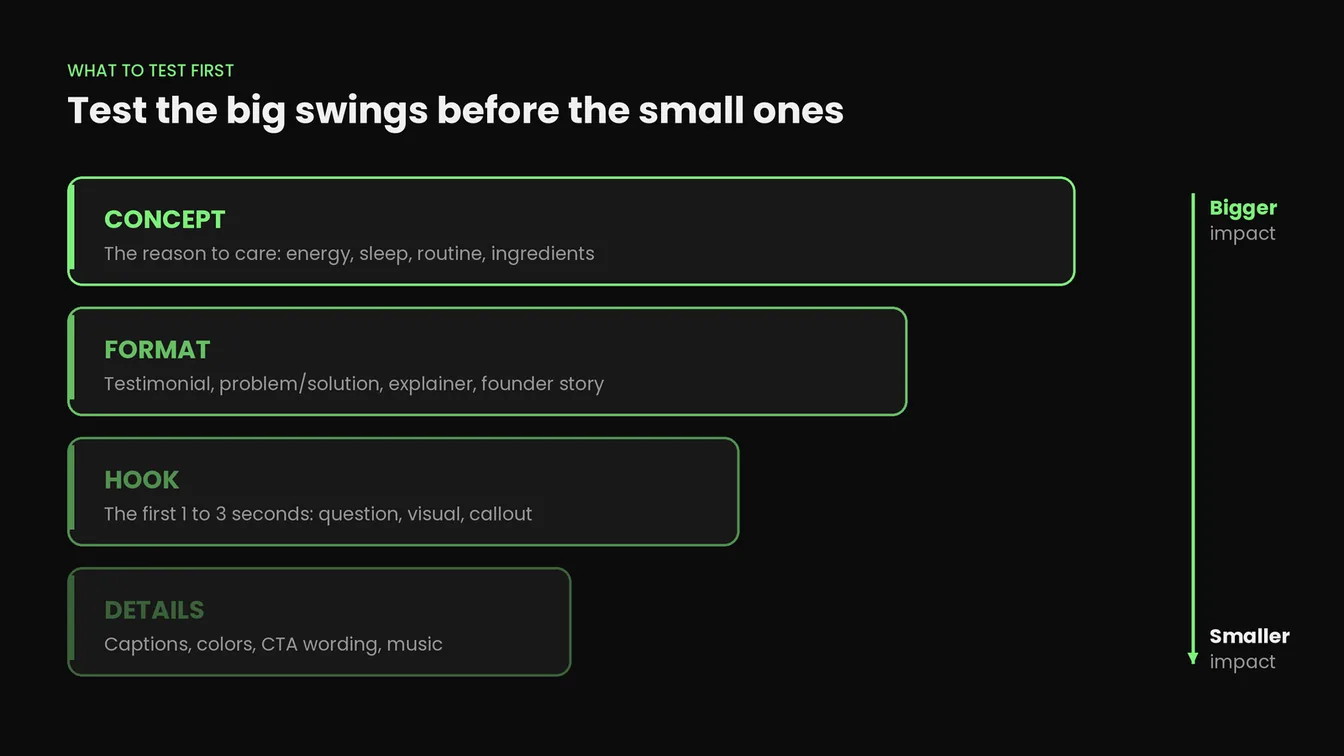
Concept. The core reason to care. For a magnesium product that might be better sleep, calmer evenings, or muscle recovery after training. Same product, completely different people stopping to watch. Concept is where the biggest swings in performance usually come from, so it is where testing should start.
Format. How the concept is delivered. A talking-head testimonial, a problem and solution skit, an ingredient explainer, a founder story, a routine or unboxing video. The same concept can win in one format and fall flat in another.
Hook. The first one to three seconds. A question, a surprising visual, a direct callout to the viewer, a bold statement. Once you know a concept and format work, new hooks are the cheapest way to extend the life of that ad.
Details. Captions, colors, music, call-to-action wording, end cards. These matter, but they rarely rescue a weak concept. Test them last, and only on ads that are already working.
The mistake we see most often is brands starting at the bottom of this list. They test ten versions of a caption on one concept, find a small difference, and call it a learning. Start at the top, and the small stuff becomes worth testing later.
Building a test batch: the creative matrix
A good test batch is small and varied, not large and repetitive. Meta's ad system groups ads that look and feel alike, so fifty near-identical variations can behave like a single ad. We covered that in more detail in our post on creative diversity.
The simplest way to build a varied batch is a matrix. Pick three concepts you believe in and three formats you can produce well. Each cell in the grid becomes one ad, with a different person and setting so no two ads look like siblings.
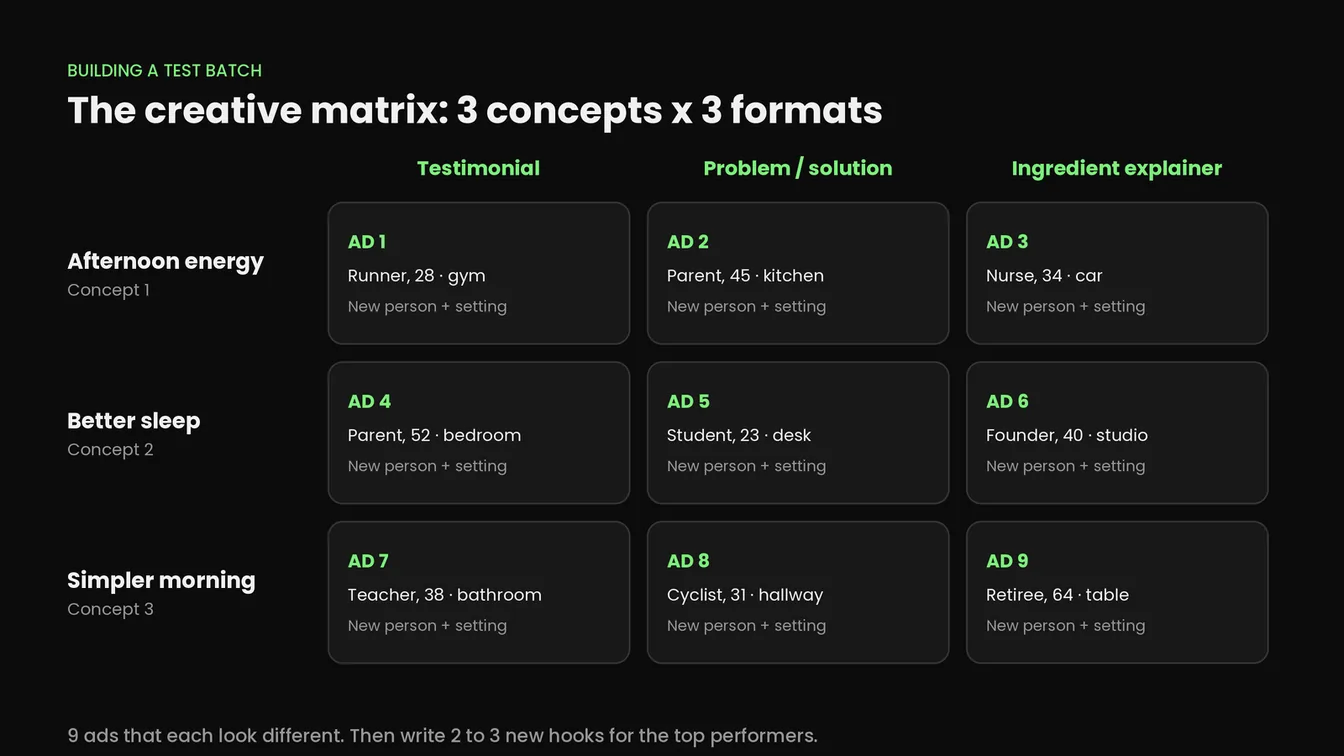
That gives you nine ads that each answer a different question. When results come in, you can read them two ways: which concept is pulling ahead across formats, and which format is pulling ahead across concepts. That is far more useful than knowing that "ad 6 won."
Once you have a clear direction, go back and write two or three new hooks for the top performers. That is your second, cheaper round.
A few practical notes on building the batch:
Pull concepts from real customer language. Reviews, support tickets, comments, and sales calls are full of the exact words people use to describe their problem. Those words make better concepts than anything invented in a brainstorm.
Keep one current best ad running as a control. New ads should be judged against what already works, not against each other in a vacuum.
Plan the batch before you shoot. It is much cheaper to capture three people in three settings on one production day than to go back for more footage later.
How to set up tests on Meta
There is no single right setup, and Meta changes its tools often. These are the three structures most supplement brands use today.
Meta's built-in creative testing tool. Inside Ads Manager you can add between two and five test ads to an existing ad set. Meta splits the test budget evenly and shows each person only one version, so it works like a real A/B test. This is the cleanest option when you want a fair read on a small set of ads, like the top of your matrix.
A dedicated testing campaign. A separate campaign, usually with a fixed daily budget, where new ads go first. Winners get moved into your main scaling campaign. This keeps testing spend predictable and stops new ads from disrupting what is already working.
Testing inside your main campaign. You add new ads straight into the campaign that is already spending, and let Meta decide how much each ad gets. This is the fastest and uses the algorithm fully, but the results are harder to read, because budget will not be split evenly and some ads will barely spend.
Whichever you choose, keep in mind that Meta generally needs around 50 optimization events per ad set per week to leave the learning phase. If your budget can't produce that many purchases, consider fewer ad sets, a larger budget per test, or an earlier event to optimize for.
One more thing specific to our category: if your ad account has been classified as health-related, Meta may limit which lower-funnel events you can optimize for. We wrote about that change in a recent insight. It doesn't stop you from testing creative, but it does change which metrics you will lean on to judge it.
Testing on TikTok and other platforms
The same principles apply everywhere, but the pace changes.
On TikTok, creative tends to wear out faster than on Meta, sound matters more, and ads that look like native TikTok videos usually outperform polished ones. Plan for more frequent, smaller batches and treat the hook as the main thing you test.
On YouTube Shorts, the first two seconds decide almost everything, and ads need to be built vertical from the start rather than cropped from a horizontal edit.
On Amazon Sponsored Brand Video, people are already searching with intent to buy. Clear product, clear benefit, and fast pacing matter more than storytelling. A winning Meta concept often needs a different cut to work there.
The takeaway: don't assume a winner on one platform is a winner everywhere. Retest the concept in each platform's native format.
How long to run a test, and when to call it
Most bad testing decisions happen too early. An ad that looks expensive on day two can be your best performer by day seven, and the reverse is just as common.
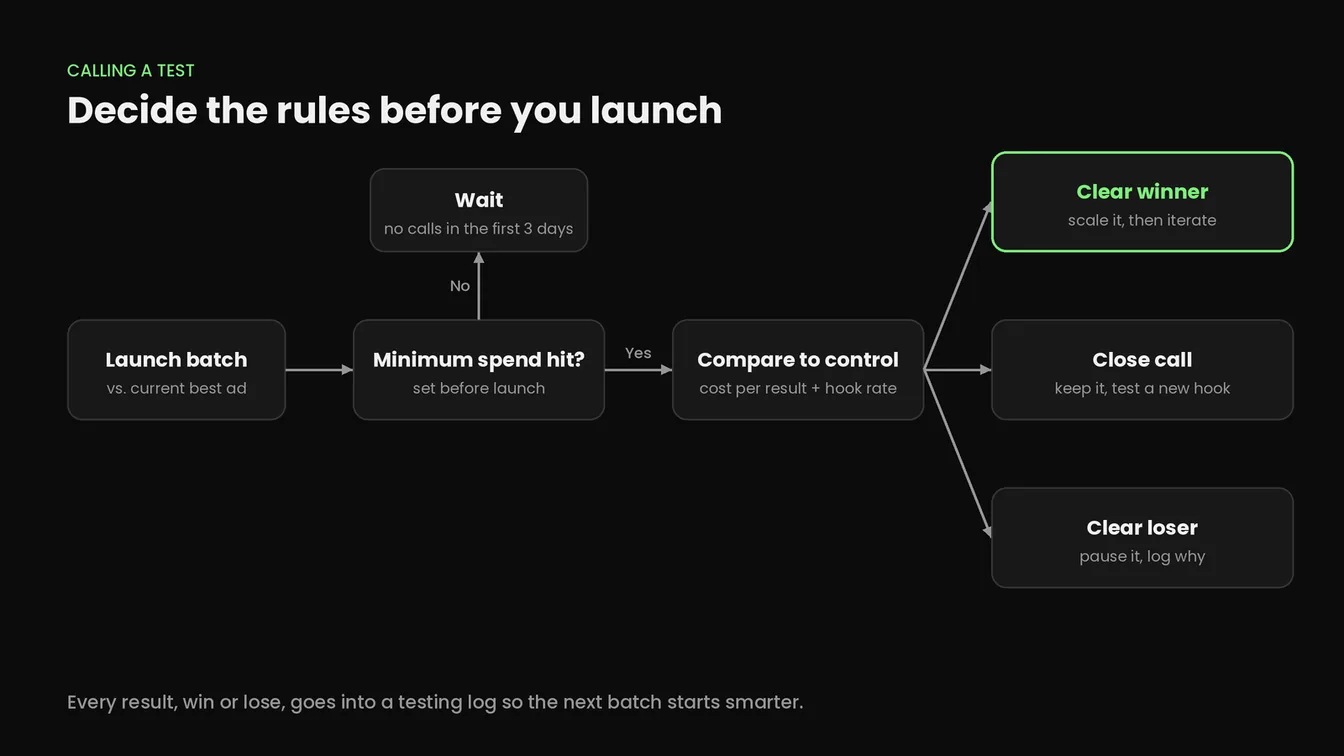
The fix is to set your rules before launch, write them down, and stick to them. The rules we suggest:
A minimum spend per ad before you judge it. A common rule of thumb is two to three times your target cost per purchase. If your target is $40, an ad should spend $80 to $120 before you decide anything about it.
No decisions in the first three days, unless something is clearly broken. Delivery is uneven early on while the platform figures out who to show the ad to.
A clear bar to beat. Decide in advance what counts as a win, for example a cost per purchase at or below your current best ad. Anything well above that after the minimum spend is a loss.
Then sort every ad into one of three buckets. A clear winner gets more budget and becomes the base for the next round of iterations. A close call stays live, and you test a new hook on it. A clear loser gets paused, and you write down why you think it lost.
Reading the results
Cost per purchase tells you whether an ad worked. It doesn't tell you why. For that, you need to look at where people dropped off.
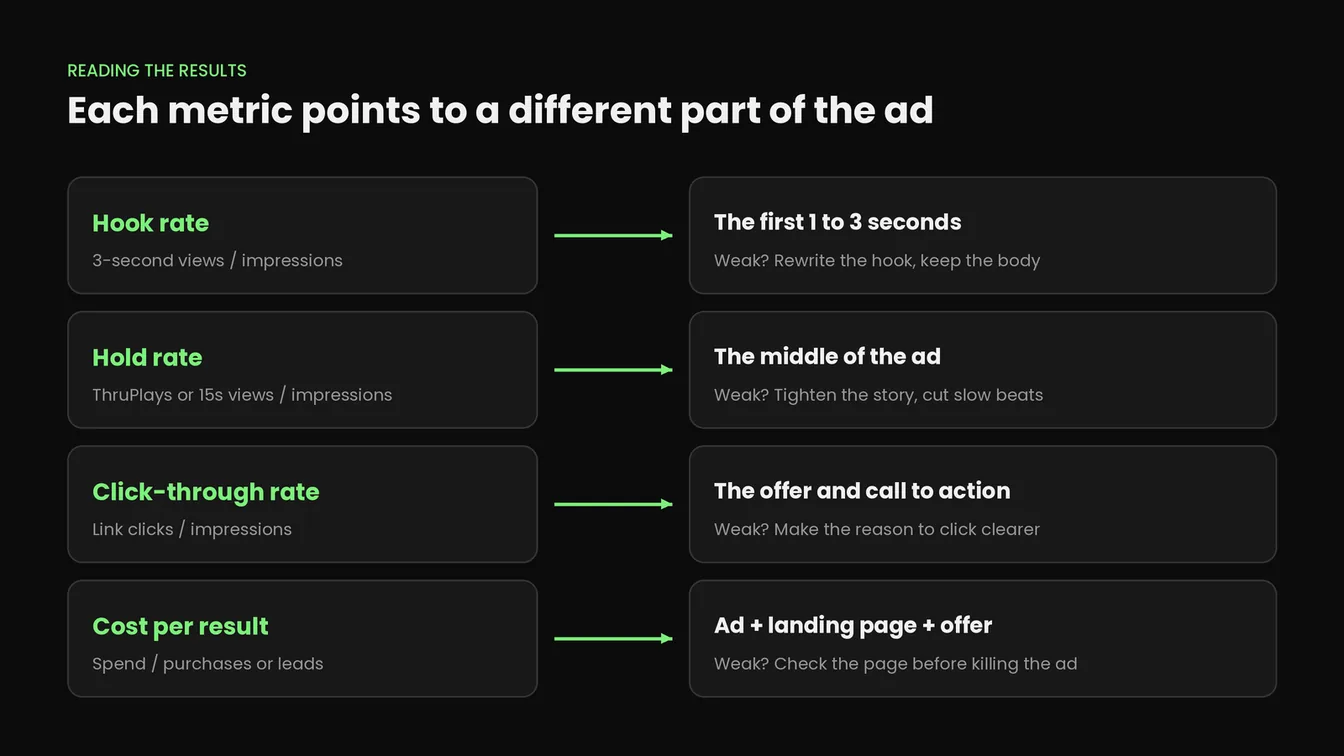
Hook rate, roughly 3-second views divided by impressions, tells you whether the opening stopped the scroll. If it is weak, rewrite the first few seconds and keep the rest.
Hold rate, ThruPlays or 15-second views divided by impressions, tells you whether the middle of the ad kept people watching. If people stop early, the story is too slow or the promise from the hook isn't paid off.
Click-through rate tells you whether the offer and call to action gave people a reason to act.
Cost per result tells you how everything worked together, including the landing page and offer. If an ad has a strong hook rate, strong hold rate, and good click-through, but a poor cost per purchase, check the landing page before you kill the ad. The creative may be doing its job.
These signals are also your best friend when conversions are thin. If you can't spend enough to get many purchases per ad, hook and hold rates still show you which openings and stories are worth building on.
Turning results into the next batch
The value of testing compounds only if you keep what you learn.
Keep a simple testing log. One row per ad: concept, format, hook, person and setting, spend, hook rate, hold rate, cost per result, and one line on why you think it won or lost. A shared spreadsheet is enough.
Look for patterns across batches, not single winners. After three or four rounds, you will start to see which concepts reliably work for your brand, which formats your audience responds to, and which hooks keep showing up in the winners.
Split each new batch between exploring and building. A practical starting point is to spend most of the batch iterating on what you know works, and keep a smaller share for brand new concepts, so you always have the next winner in development before the current one wears out.
Keep compliance in every round
Testing more ideas means more scripts, more on-screen text, and more chances for a claim to slip through. Every new variant, including a small hook change, should go through your own compliance review before it goes live. Structure and function language, testimonials framed as one person's experience, and no before-and-after or implied transformation visuals are good starting rules, but platform policies shift often.
Compliance sign-off is always the brand's own responsibility. What a production partner can do is write and shoot with those rules in mind from the start, so fewer ideas stall at review.
Common mistakes
Testing details before concepts. Uploading dozens of near-identical variations and calling it a test. Judging ads on two or three days of spend. Having no control ad to compare against. Killing an ad with strong hook and hold rates because of a landing page problem. Assuming a Meta winner will win on TikTok or Amazon. And the most expensive one: running tests without writing down what you learned.
Frequently asked questions
How many ads should a supplement brand test at once?
For most brands spending at a moderate level, a batch of six to twelve structurally different ads is a good starting point. It is enough variety to learn something, and small enough that each ad gets enough spend to be judged fairly.
How much budget do I need for creative testing?
Work backward from your target cost per purchase. If each ad needs two to three times that amount before you judge it, multiply by the number of ads in the batch. That tells you what a test really costs, and whether you should run fewer ads per batch.
Should I use Meta's creative testing tool or a separate testing campaign?
Use the built-in tool when you want a clean, even comparison between two to five ads. Use a separate testing campaign when you want predictable testing spend and want to protect your main campaign. Many brands use both.
How often should we refresh creative?
It depends on spend and platform, but watch for rising frequency, a falling hook rate, and a climbing cost per result on your best ads. Those are signs of fatigue. Having the next batch already in testing before that happens is the goal.
Can AI-generated ads be used in creative tests?
Yes. AI tools make it much faster to produce variations of a concept with different people, settings, and formats. The important part is that a person still owns the strategy, the script, and the compliance review. AI handles volume, not judgment.
Testing only works if you can produce enough different ads to test.
That is usually where teams get stuck. We plan and produce structurally different supplement video ad batches in 3 to 10 days, built around concepts, formats, and hooks worth testing. Book a call at design4.ca/book and we'll map out your first test matrix together.
Ready to build a testing batch that teaches you something?
We plan and produce structurally different supplement video ads in 3 to 10 days, built around concepts, formats, and hooks worth testing.
See related work in our portfolio, or explore more guidelines.
Get 10 free static ads