
The Complete Guide to Creative Briefs for Supplement Video Ads
A one-page brief is the cheapest way to make a supplement ad better. Here is how to write one that your editor, your creator and your media buyer can all act on.
Why the brief decides the ad
Most supplement ads that underperform did not fail in the edit. They failed before anyone opened an editing timeline. The brief was a product description, a mood board and a hope. The creator guessed at the angle, the editor guessed at the hook, and the media buyer guessed at what the ad was supposed to prove.
A good brief removes the guessing. It tells everyone what the ad is for, who it is talking to, what single thing it should say, and how you will judge it afterwards. It is not a long document. The best briefs we work from fit on one page, and they take an hour to write properly.

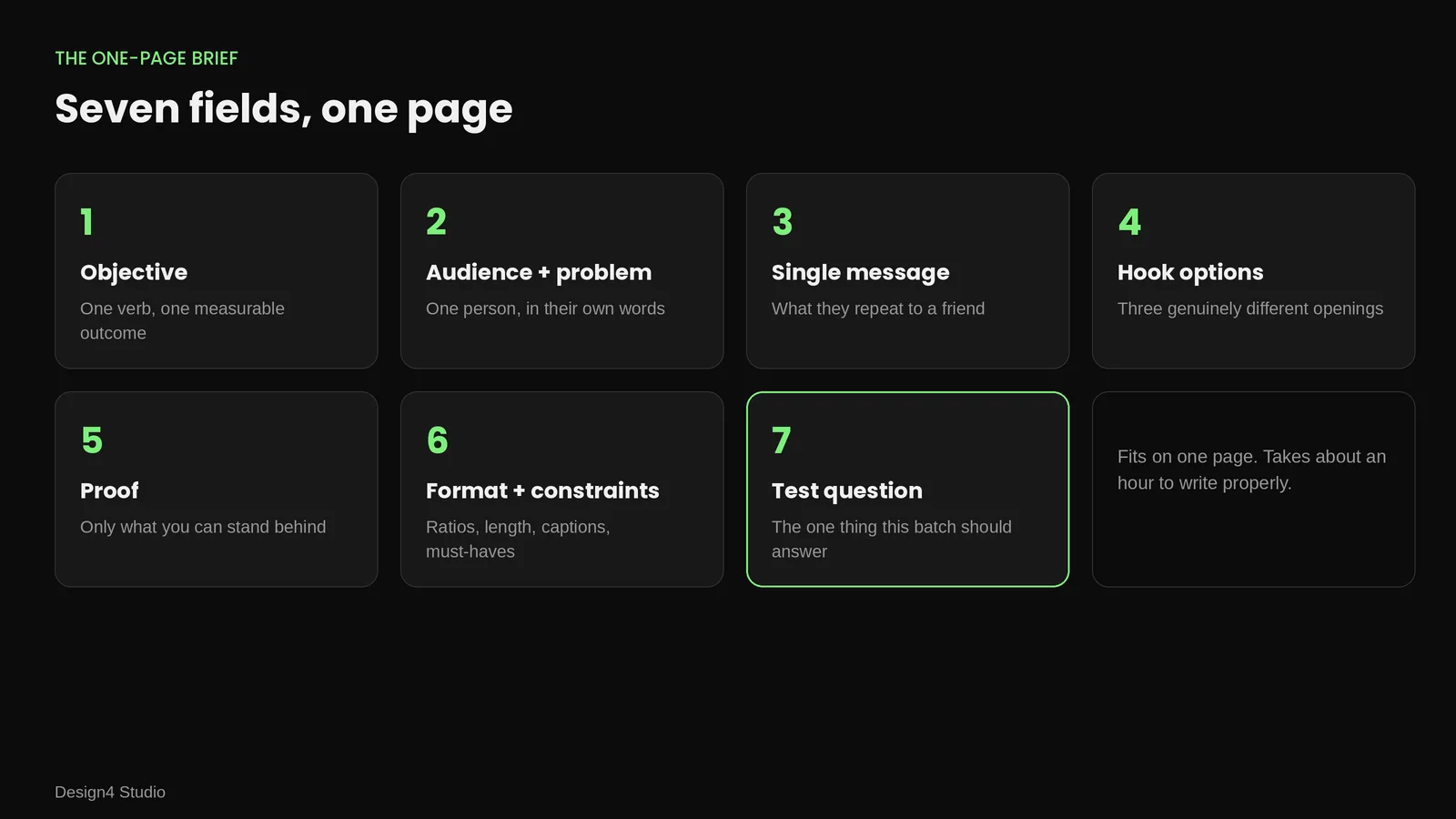
This guide covers the seven fields we put in every brief, how to fill each one in, a worked example, and the mistakes we see most often. It applies whether the ad will be shot with a creator, built with AI-accelerated production, or a mix of both.
What a creative brief is (and is not)
A creative brief is a shared agreement about one ad or one small batch of ads. It answers a simple question: what are we making, for whom, and how will we know if it worked?
It is not a script. A script is the output of the brief. It is also not a brand book. Your brand guidelines describe how you always look and sound. A brief describes what this specific ad needs to do right now.
It is also not a place to hide uncertainty. If you do not know who the ad is for, the brief is where you find that out, before you spend on production.
The seven fields of a useful brief
1. The objective
Write one sentence that starts with a verb and names a measurable outcome. "Win back lapsed subscribers with a reason to reorder" is an objective. "Raise awareness" is not, because nobody can tell whether it happened.
Pick one objective per brief. If you want a prospecting ad and a retention ad, write two briefs. They need different hooks, different proof and a different call to action, so they are different ads.
2. The audience and the problem
Describe one person, not a demographic. Start with the situation they are in when they see the ad, then the problem they would describe in their own words. "Women over 40" is a targeting setting. "Someone who wakes at 3am, scrolls her phone, and dreads the next day" is an audience.
Use the language of real customers. Reviews, support emails and survey answers are the best source. Copy the phrases people actually use, because those phrases make the strongest hooks.
Be careful with outcomes. Compliance is always your own responsibility, and platform and regulator rules on health claims are strict. Write the problem as a lived experience, not a medical promise, and have your own reviewer check the final ad.
3. The single message
Every ad gets one message. Write it as a sentence a viewer could repeat to a friend. "This gummy replaces my evening routine of three separate products" is a message. "High quality, natural, effective and affordable" is a list, and lists do not get remembered.
A useful test: if the viewer remembers only one thing, what should it be? Put that in the brief. Everything else in the ad exists to support it.
4. The hook options
The first two seconds decide whether the rest is seen. Do not ask for one hook. Ask for three, and make them genuinely different from each other, not three rewordings of the same line.
Different hook types work for different audiences. A problem hook opens on the frustration. A curiosity hook opens on a surprising question. A demonstration hook opens on the product in use. A social hook opens on a person who looks like the viewer. Write one of each in the brief so the testing plan has real variety. Our 12 hooks article lists patterns worth borrowing.
5. The proof
Say what makes the message believable, and be honest about what you actually have. Proof can be a real customer voice, a visible product detail, an ingredient explanation, a certification you hold, or a clear demonstration of how the product is used.
List the proof you are allowed to show and the proof you cannot show. If you cannot support a claim with something you can stand behind, it does not belong in the ad, however good it sounds in a meeting. Never invent a number, a testimonial or a result to fill a gap.
6. The format and the constraints
State where the ad will run and in what shape. A vertical 15 to 30 second video for Meta and TikTok needs a different structure from a 30 second horizontal spot or an Amazon Sponsored Brand Video. Name the aspect ratios, the length, whether captions are required and whether the ad will be sound-off by default.
Add the practical constraints. Which product shots exist? Is there a creator, a location or a voiceover? What must appear in the ad (a product image, a required line) and what must never appear? The more of this you write down, the fewer revision rounds you pay for. Our shot language guide gives you the vocabulary to describe the visuals precisely.
7. The test question
This is the field most briefs leave out, and it is the one that makes the brief pay for itself. Write the question this ad is meant to answer. "Does the sleep-routine angle beat the stress angle for returning customers?" is a test question. It tells the editor which variables must stay the same and which must change.
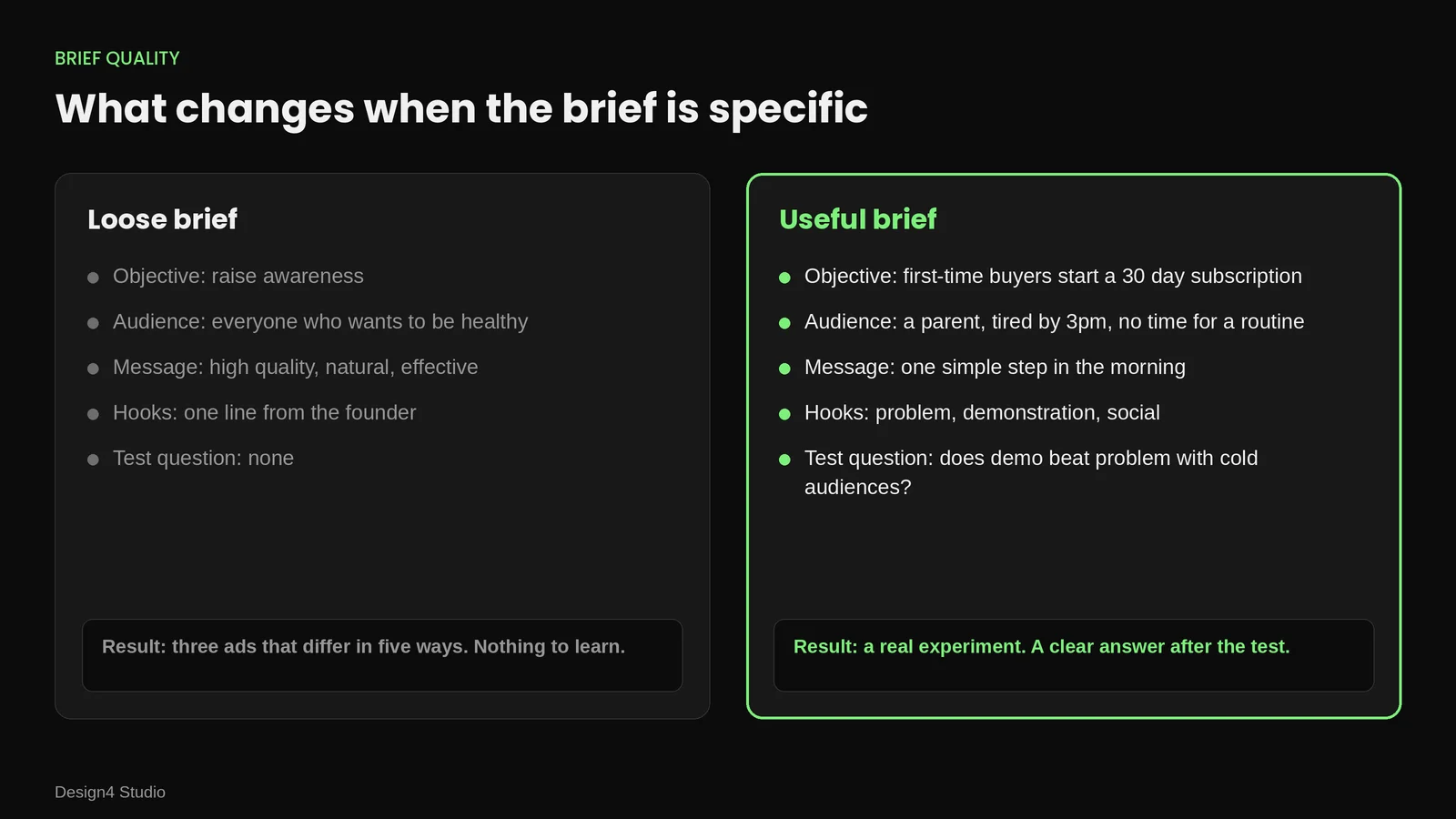
Without a test question, you end up with three ads that differ in five ways at once, and no result you can learn from. With one, the batch is a real experiment. Read our creative testing guide for how to structure the batch and read the results.
A worked example
Here is a short illustrative brief for an imaginary evening-routine supplement. The product and details are invented for the example.
Objective: Get first-time buyers to start a 30 day subscription.
Audience and problem: A parent in their late 30s who is tired by 3pm and does not want another complicated routine. In their words: "I just need to get through the afternoon without crashing."
Single message: One simple step in the morning, built into a routine you already have.
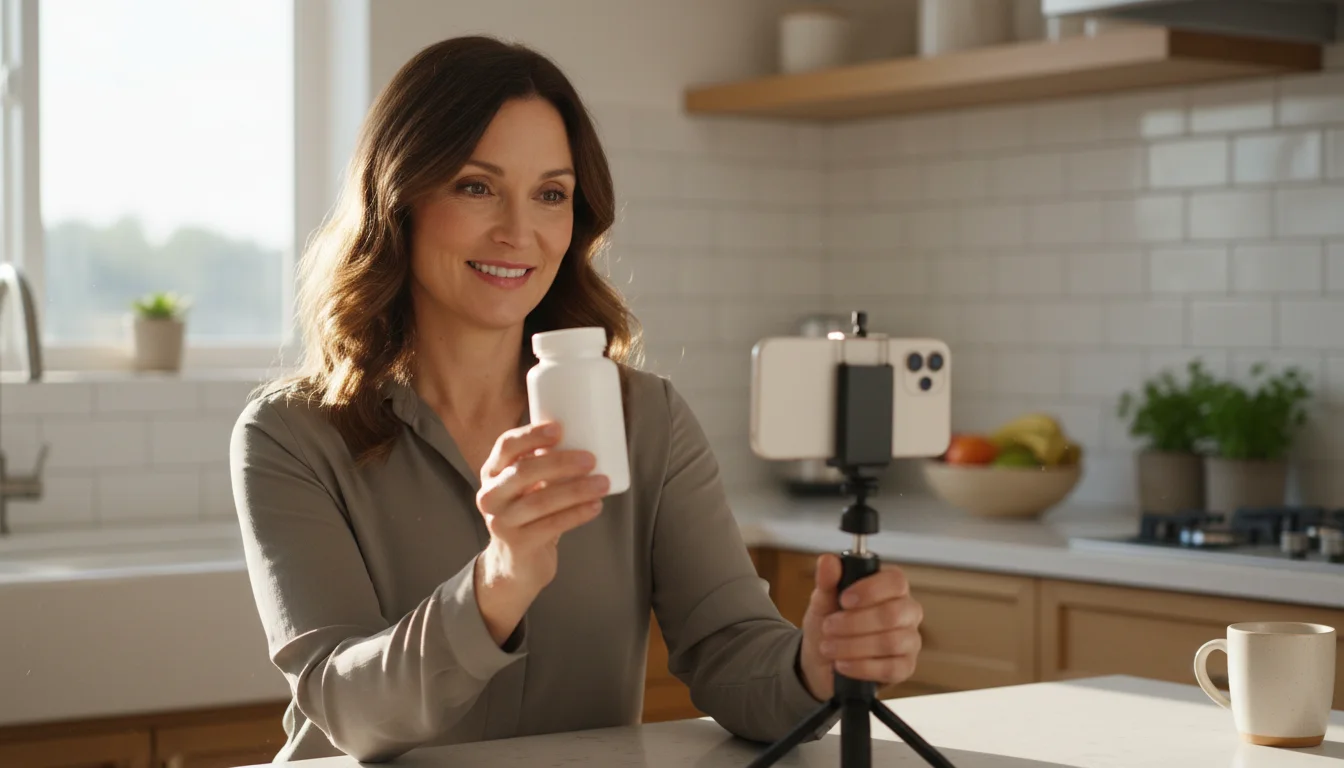
Hooks: (a) Problem: "The 3pm slump is not a personality flaw." (b) Demonstration: a hand placing the jar next to the coffee machine. (c) Social: a parent filming a quick kitchen-counter story.
Proof: A real customer voice (with written permission), a clear shot of how it is taken, and a plain explanation of what is inside. No performance numbers.
Format: 9:16 at 20 seconds with captions, plus a 1:1 cut. Sound-off friendly.
Test question: Does the demonstration hook beat the problem hook with cold audiences?
Notice what the brief does not contain: adjectives about the brand, a list of five benefits or a request to "make it pop". It contains decisions.
How to run the briefing process
Writing the brief is half the job. The other half is how it gets used.
Start with a short kickoff. Walk the creator or editor through the page out loud. Ten minutes of conversation catches more misunderstandings than ten rounds of written comments.
Share reference ads, but explain what you like about each one. "I like how this opens on a hand, not a face" is useful. "Make it like this" is not.
Agree what "done" looks like before production starts. A first cut, a revision round and a final delivery is a normal rhythm. Decide who approves, and who checks claims against your own compliance rules, so nothing waits on a stranger at the end.
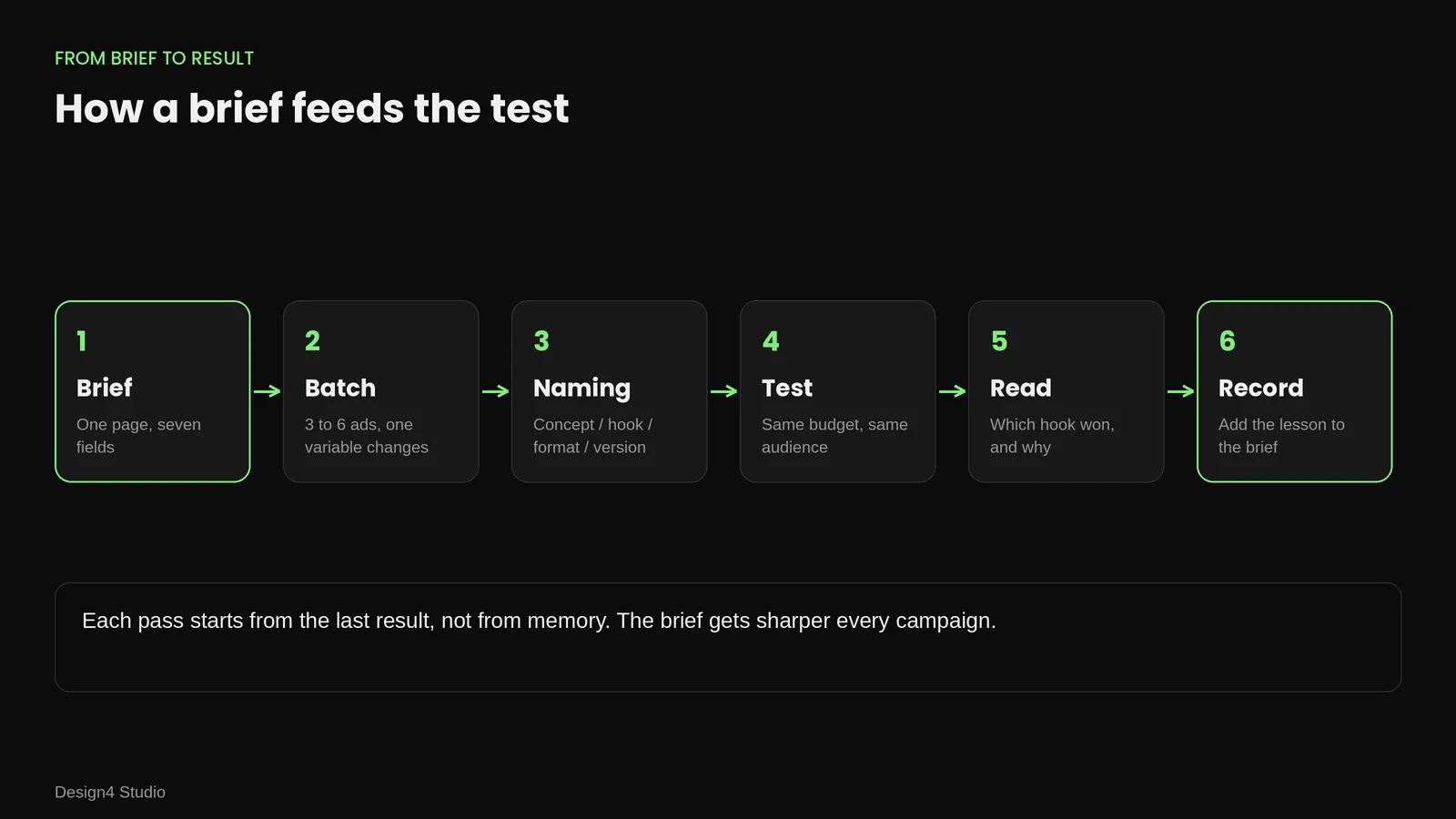
Keep the brief alive. After the ads run, add what you learned to the bottom of the page. Next month's brief starts from that record instead of from memory.
Briefing for AI-accelerated production
AI-accelerated production is fast, which makes a loose brief expensive in a new way. You can generate a lot of wrong ideas very quickly. A clear brief keeps the speed pointed at the right target.
Be specific about people, settings and product handling, because those are the details generated imagery and video can get wrong. Describe the person, the room, what is in their hand and what the camera is doing. Reference the real product so every shot matches it, and say plainly where a real shoot is needed instead of generated footage.
Keep a human accountable for the result. Every ad should have a person who reviewed it for accuracy, brand fit and compliance before it went live.
Turning the brief into a naming system
A brief pays off a second time when its fields become the names of your ads. Give every ad a name built from the brief: the concept, the hook type, the format and the version. "Routine / Demo hook / 9x16 / v2" tells your media buyer exactly what they are looking at in the ads list, months after the shoot.
Consistent names make results comparable. When every ad carries the same fields, you can sort by hook type and see which opening works with cold audiences, or sort by format and see which cut earns its place. Without them, you are decoding file names like "final_final_new" and guessing.
Store the brief and the ads together. A shared folder with the one-page brief at the top, the delivered files below and a short results note at the bottom becomes a record your whole team can learn from. Over a few campaigns, that record becomes the most useful asset you own, because it shows what your customers respond to in your category, not what a generic best-practice list says.
Common mistakes
Writing a product description instead of a brief. Listing features tells nobody what to make.
Asking for everything. An ad with five messages communicates none of them. Choose one.
Skipping the audience. "Everyone who wants to be healthy" is not someone the creator can picture.
Briefing one hook. If the hook fails, the whole ad fails and you have learned nothing. Always ask for options.
Leaving out the test question. Without it, variations are random rather than designed.
Treating the brief as a contract to defend. It is a working tool. If the first cut shows the angle is wrong, change the brief and say so.
Forgetting compliance. Health claims need your own review at the brief stage, not after the edit is finished.
Frequently asked questions
How long should a creative brief be?
One page is enough for most ads. If you cannot fit it on a page, the objective or the message is probably still unclear. Long briefs tend to hide the decisions that matter.
Who should write the brief?
Whoever owns the result should own the brief, usually the marketer or founder who understands the customer and the numbers. Editors and creators should be able to question it, but they should not have to invent the strategy.
How many ads should one brief produce?
A small batch, often three to six, built around one test question. That is enough variety to learn something without turning the brief into a catalogue.
Do I need a new brief for every ad?
No. A single brief can cover a batch, as long as the objective, audience and message are the same. Write a new one when any of those change.
Can I use the same brief for creators and for AI-accelerated production?
Yes, and it helps. The seven fields stay the same. For AI-accelerated work, add more detail about people, settings and product handling, and note which shots must be real.
Get a brief that is ready to produce
Design4 Studio produces human-directed, AI-accelerated video ads for supplement and wellness brands, with an 8 to 12 day turnaround. If you would like help turning your next campaign idea into a brief and a batch of ads, book a call and we will take it from there.